
NASA's X-59 supersonic jet has moved from a striking experiment to a serious test of aviation's future. The needle-shaped aircraft has now flown faster than sound and reached the conditions needed for its main research mission. NASA wants supersonic flight without the window-rattling boom.
That goal matters because speed was never the only problem facing supersonic passenger travel. Noise kept aircraft such as Concorde from flying at full speed over populated land. The X-59 could help remove that barrier by replacing the boom with a much softer thump. Success could open more routes and make faster air travel useful far beyond ocean crossings.
How NASA's X-59 Softens a Sonic Boom
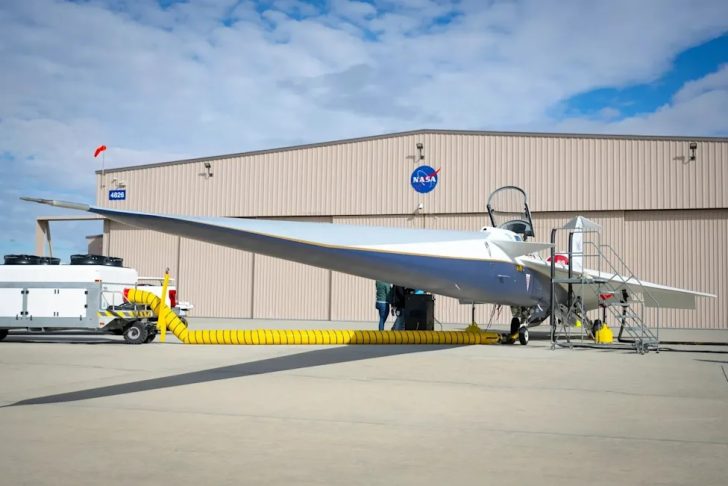
The News / Aircraft create pressure waves as they push through the air. Once a plane breaks the sound barrier, those waves can merge into strong shock waves. People below hear a sudden sonic boom.
That sound follows the aircraft along its supersonic route and can affect many communities.
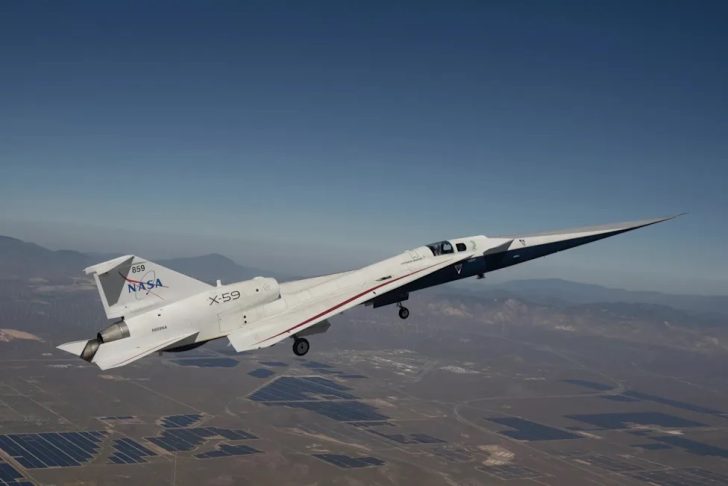
The X-59 tackles that problem through its shape. Its thin nose stretches for about one-third of the aircraft's 99.7-foot length. That long profile separates the shock waves before they can combine into one hard boom. NASA expects the smaller waves to reach the ground as a quieter thump.
Other design choices support the same goal. Engineers placed the engine above the fuselage and created a smooth lower surface. Those features direct more pressure energy away from the ground. The narrow body and carefully formed wings also control airflow. Every major curve serves the sound mission.
The unusual nose leaves the pilot without a normal forward-facing window. NASA solved that issue with its External Vision System. High-resolution cameras send a processed view to a 4K cockpit screen. The system helps the pilot see ahead and below, especially during landing.
The X-59 Has Already Cleared Major Flight Tests
The first flight arrived on October 28, 2025, after years of development by NASA and Lockheed Martin Skunk Works. Test pilot Nils Larson kept the X-59 below the sound barrier during the 67-minute trip from Palmdale to Edwards, California. The plane reached about 230 mph and 12,000 feet while the team checked its handling and systems.
Engineers then expanded the flight envelope in careful stages. They raised the speed, altitude, and difficulty across repeated test flights. That steady work led to June 5, 2026, when NASA test pilot Jim “Clue” Less took the X-59 beyond Mach 1. The aircraft reached roughly Mach 1.1, or 713 mph, at 43,400 feet during an 81-minute flight.
That achievement proved the X-59 could operate beyond the sound barrier, but NASA still needed to reach full mission conditions. The aircraft did so on June 12. It climbed to 55,000 feet and hit Mach 1.4, about 924 mph. Those figures match the planned conditions for later flights over selected American communities, making the test a major step for the Quesst mission. NASA confirmed the milestone after the flight.
The quiet part still needs direct proof. NASA used an F-15 chase plane during the early supersonic flights, and that aircraft produced traditional booms that covered the X-59's sound. Researchers will next measure the X-59's pressure signature with airborne instruments. A later acoustic validation phase will determine if the thump matches predictions across different speeds, heights, and weather conditions.
What the X-59 Could Change for Air Travelers?
GTN / NASA will eventually fly the aircraft over several communities and ask residents what they heard and how the sound affected them.
Ground sensors will record the noise at the same time. That pairing matters because a technically quiet sound may still bother people after repeated exposure. Regulators need public response data before setting a fair limit for routine flights.
The agency will share its results with the Federal Aviation Administration and international regulators. The FAA currently aims to replace the old blanket restriction with noise-based standards and finalize two related rules by mid 2027. One rule would cover operational certification, while another would set acceptable noise thresholds for takeoff, landing, and supersonic cruise.
Clear noise limits could give aircraft makers a real target. Companies could design planes around measured standards instead of guessing what regulators might accept. Airlines could then consider supersonic routes across continents rather than limiting fast travel to oceans. That wider network would make the technology more useful.
